Florida Humanitarian Parole Update: Beware Of Sponsorship Scams

Part of the Florida humanitarian parole program is having a sponsor in the U.S. This need has given rise to sponsorship scams, as our immigration attorney explains.

Earlier this year, the Biden administration widened the humanitarian parole program to include citizens of Haiti, Nicaragua, Venezuela, and Cuba. The program was created to give refuge to those who are fleeing the economic and humanitarian crises facing them in their home countries. Ukraine was recently added to this list to assist those looking to flee the war-torn country.

The United States has stated that it will accept up to 30,000 non-citizens each month from these countries under the following conditions:

  • They must pass a thorough background check.
  • They must have all required vaccinations.
  • They must have a sponsor in the United States.

How Does Sponsorship Work?

A key element to being allowed entry into the United States under the humanitarian parole program is having someone in the U.S. who can help the applicant logistically and financially while in the country. If someone who is looking to come to the U.S. under this program does not have family members here and does not know who to contact for sponsorship, they may seek out strangers to sponsor them.

Sponsors For Sale

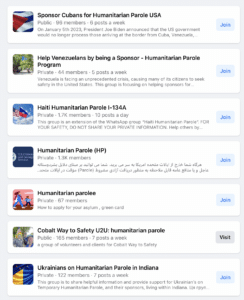
Some seeking refuge in the U.S. are searching the internet for sponsors. A quick Facebook search for “humanitarian parole sponsor” reveals many pages and groups claiming to match sponsors to individuals who need them. While many of these posts are from U.S. citizens legitimately wanting to help immigrants with sponsorship, others demand thousands of dollars upfront with no promise to deliver on the sponsorship arrangement.
Florida Humanitarian Parole

Legal Loophole

Currently, it does not appear that charging someone a “fee” for sponsorship is against the law. As long as the forms are correctly filled out, and the other requirements are met, having a sponsor is all that is left to gain access to the U.S. Many seeking asylum are leaving their home country because of financial and economic hardship and it does seem counterintuitive to pay someone who is then supposed to financially support the person once in the U.S.

Legitimate Sponsorships

While some are looking to make money to sponsor immigrants, plenty of others want to sponsor individuals and families for free. Websites like Welcome.US can match well-meaning U.S. citizens with those who need sponsorship for Florida humanitarian parole access. Other non-profit organizations like USAHello offer program information to immigrants and are an excellent way to help support our immigrant community.

Beware Of Scams

Anytime there is a desperate need, someone is looking to exploit that need for profit. Unfortunately, this is not uncommon with new immigration programs. The USCIS is aware of these scams and issued this statement,

“Fulfilling our humanitarian mission while upholding the integrity of the immigration system is a top priority for USCIS.” The statement went on to say the agency “carefully vets every prospective supporter through a series of fraud- and security-based screening measures. Additionally, USCIS thoroughly reviews each reported case of fraud or misconduct and may refer those cases to federal law enforcement for additional investigation.”

Florida Humanitarian Parole

The Immigration Attorneys at Casais & Prias Can Help

If you know anyone seeking sponsorship for the Florida humanitarian parole program, we can guide you as you help them find a legitimate sponsor. If you have any questions about this program or any other immigration matters, please contact us. Our immigration lawyers are available to discuss your case and help you in any way we can.


Can You Gain Citizenship Through Gay Marriage? Our Miami Beach Immigration Lawyer Explains

Same-sex couples have the same immigration rights in the U.S. as heterosexual couples. However, obtaining citizenship through marriage can be more of a challenge, as our Miami Beach immigration lawyer explains.

After the Defense of Marriage Act was deemed unconstitutional by the U.S. Supreme Court in 2013, same-sex couples can enjoy the same immigration benefits as opposite-sex couples. Our Miami Beach immigration lawyer has handled numerous cases involving gay marriage and immigration, so he knows that obtaining citizenship through marriage for a same-sex couple can be more challenging.

Immigration Through Marriage

The immigration process works the same way for opposite-sex and same-sex couples. When a non-citizen marries a U.S. citizen, that individual becomes eligible to apply for a Permanent Resident Card (commonly called a green card). A non-citizen does not automatically become a U.S. citizen through marriage.

Establishing eligibility for a green card is lengthy and can take anywhere from nine months to three years. It can take longer if the sponsoring spouse is a green card holder and not a U.S. citizen.

How Does Immigration Through Marriage Work?

A couple seeking to gain U.S. citizenship for a non-citizen through marriage must follow the process set by the United States Citizenship and Immigration Service  (USCIS).

Establishment of a Lawful Marriage

Your marriage must have occurred in a country where same-sex marriage is legal. If you were married in a place where same-sex marriage is illegal, such as India, some states in Mexico, and others, you must be married in the United States if you both live here. You can apply for a fiance visa so that your fiance can come to the U.S. for the marriage.

To establish your marriage with the USCIS, you must provide the following:

  • The U.S. citizen’s birth certificate
  • Marriage certificate
  • Joint utility bills or lease document
  • Photos from your wedding
  • Filing fee

Proof of Eligibility

Next, the non-citizen spouse will apply for a green card by providing documentation to the USCIS that proves their eligibility for residency. You will need to provide documentation that establishes the following:

  • The foreign nationality of the non-citizen spouse
  • Proof of legal entry into the U.S.
  • Medical evaluation
  • Affidavit of Support from the U.S. citizen spouse
  • Filing fee
  • Biometrics fee

Interview with USCIS

Once the paperwork has been completed and submitted, the non-citizen spouse will be interviewed by a USCIS representative to establish their eligibility for green card status. Getting to the interview portion of the process can take up to a year.

During the interview, the USCIS official will ask both spouses questions about their relationship to establish that the marriage is legitimate and not just for immigration purposes.

After the interview, the petition can be approved immediately or within a few days. Once your case is approved, you will receive a notice by mail, and the non-citizen spouse will receive a physical green card in a few weeks.

Obstacles For Same-Sex Couples In Immigration

Although the rights and responsibilities are the same for same-sex and heterosexual couples trying to gain residency through marriage, same-sex couples can face unique challenges. Our Miami Beach immigration lawyer has seen the following issues arise in same-sex marriage cases.

Miami beach immigration lawyer

Civil Unions

Before same-sex marriage was legal in all 50 states, many couples chose to have a civil union ceremony. These unions are not legally binding for immigration purposes. Couples must convert the civil union to marriage or have a separate marriage ceremony to be considered for immigration benefits.

Issues With Family

Part of the green card application process is establishing the legitimacy of the same-sex marriage. Marriage photos may not include one or both spouses’ parents. When family members are opposed to the wedding because of personal feelings, one spouse may have limited information about the family of the other spouse. These family dynamics can be explained during your USCIS interview.

Past Opposite-Sex Marriage

It is not uncommon for a same-sex spouse to have a history that includes an opposite-sex spouse. While this history may cause the interviewer to ask some questions, it is not a reason for concern. Fully disclose any past marriages and explain your particular circumstances.

Casais & Prias Can Guide You Through The Immigration Process

As you can see, gaining a marriage green card is a lengthy, complex process. If you fail to submit the required documents on time, your spouse’s citizenship can be delayed or even denied. Contact our Miami Beach immigration lawyer to discuss your case, and let us help you establish citizenship for your spouse.

Do You Need A Miami Citizenship Lawyer For Gay Marriage Immigration?

Although same-sex married couples have the same rights as heterosexual married couples, immigration for same-sex spouses can pose some challenges, which is why you need a Miami citizenship lawyer to help with your case.

Managing partner Rolando Casais, Jr. explains the LGBT asylum process.

The Supreme Court struck down the Defense of Marriage Act in 2015, making gay marriage legal across the country. This ruling gave the same rights to same-sex couples as heterosexual couples.

As a result, the United States Citizenship and Immigration Service (USCIS) now views all marriages equally when evaluating green card applications. If you are a same-sex spouse of a U.S. citizen or lawful permanent resident, you can apply for a marriage green card, just as you could if you were a heterosexual spouse.

There are some challenges that same-sex couples face when navigating the immigration process, so our Miami citizenship lawyer put together a list of tips to help you and your spouse.

Proof Of Bona Fide Marriage

All married couples must prove to the USCIS that their marriage is legitimate and based on love, not on the need for immigration status. The following documents serve as proof of bona fide marriage:

  • Mortgage or lease documents showing both spouses’ names
  • Utility bills with both spouses’ names
  • Driver’s licenses showing the same address
  • Bank statements or credit card statements showing the same address
  • Letters from friends, family, or employers showing the same address
  • And others

Knowledge of Spouse’s Parents

During the interview process with a USCIS official, each spouse will be asked questions about the other spouse. These are questions that spouses typically know about the other such as the other spouse’s parents’ names. However, some same-sex couples feel they cannot introduce their significant other to their parents because they do not share the same views on same-sex relationships.

This is a valid concern, and we recommend that, even if your spouse does not know your parents, they still learn details about them, including their names, ages, and cities of residence.

Proving Residence Without Documentation

Housing discrimination is still possible in some areas, and if you live in a place where your landlord may discriminate against your same-sex spouse being on your lease, you may choose to leave them off. Not having a housing document with both spouses’ names on it can present a problem when trying to prove a bona fide marriage.

While this arrangement can be a legitimate response to a fear of discrimination, it can also raise red flags to the USCIS since they need to see that you and your spouse are living together and sharing financial assets. If you cannot produce a joint lease agreement, our Miami citizenship lawyer recommends that you provide other documentation, such as a utility bill with both of your names on it, or show that you are each other’s beneficiary on a life insurance policy.

miami citizenship lawyer

Proof Of Legal Marriage

Not only does your marriage need to be bona fide, but you must also show proof that it is legal. Same-sex marriage is still not legal in India and many other countries around the world. At the same time, it is legal in 32 countries, including the U.S.

If you were married in a country that does not recognize same-sex marriage, you will need to be married in the U.S. before applying for immigration status. And if you need a fiance visa to get married in the U.S., our Miami citizenship lawyer is prepared to assist.

Casais & Prias Can Help With Your Immigration Needs

The process of legal immigration to the United States can be complex, and if you skip a step, the process can take even longer. Our attorneys are skilled in immigration law, LGBTQ law, LGBT asylum law, and family law, and we are qualified to help with your same-sex citizenship questions. Contact us today to schedule a free case evaluation. We look forward to working with you.

Why You Need An LGBTQ Family Lawyer For Your Same-Sex Divorce In Coral Gables

If you want to end your marriage, you need to hire an attorney who specializes in same sex divorce in Coral Gables. Our LGBTQ family lawyer explains.

Although same sex divorce has the same rules as heterosexual divorce, there are some details unique to the same sex community that can make divorce tricky. In 2015, same sex couples gained the same rights and responsibilities as heterosexual couples when they marry and when they divorce. Regardless of where your marriage took place, if you have been served with divorce papers or are seeking a divorce in Florida, our family attorney at Casais & Prias can help.

Equitable Distribution

Many same sex couples were together for years, even decades, before same sex marriage became legal nationwide. They may have purchased homes and vehicles, and obtained other assets before they were legally married. The issue with these assets is that they likely will not figure into the marital assets considered by the judge. Florida does not recognize common law spouses, so any assets obtained prior to marriage would not be divided.

For example, if the couple purchased a home in one person’s name and the other person was not added to the deed after they were married, the house would remain the property of the person on the deed. An experienced family attorney representing you in your same sex divorce in Coral Gables is the best way to ensure that your rights are protected. We will fight to obtain the assets that you are entitled to.

Alimony

Similar to assets acquired before marriage, alimony is solely based on the time the couple was married. Even if a couple lived together for 20 years before they got married, if they were only married for five years, alimony would only be based on five years. The standard basis for an alimony settlement is:

  • Income and earnings of both spouses
  • Length of the marriage
  • Needs of each spouse
  • Financial investments brought by each spouse to the marriage

This settlement can get murky when a majority of the relationship happened before marriage, and the length of the marriage has a disproportionate impact on the amount of alimony that could be awarded. This is why you need legal representation when alimony is on the table. Our experience with same sex divorce in Coral Gables makes us a helpful partner to have representing your best interests.

Child Custody

When children are involved, a divorce can be more complex. The courts can give preference to the biological parent even though parental responsibility strives to give equal responsibility to both parents. Custody can be more difficult in a same sex divorce because the child is either biologically related to only one parent or, in the case of adoption, neither parent.

To ensure that you have parental rights for your child, you must take these steps prior to your divorce:

  • If your spouse had a child before you were married, you need to adopt the child to establish parental rights.
  • If the child was born after you were married, and you are not the biological parent, you need to adopt the child to establish parental rights.
  • If the child was adopted during your marriage, you should adopt the child or include your name on the birth certificate.

Once parental rights are established, the courts should award equal time-sharing arrangements for each parent while always keeping the child’s best interests in mind.

same sex divorce in Coral Gables

Casais & Prias Can Help With Your Same Sex Divorce In Coral Gables

If you have questions about your divorce, custody, alimony, or any other matters of family law, contact us today. We can schedule a free case evaluation and devise a strategy that protects your rights. We look forward to working with you.

Our Coral Gables Landlord Attorney’s Advice For Evicting A Tenant For Non-Payment

As a landlord, it is your responsibility to handle evictions lawfully. If you are unsure how to evict a tenant for non-payment of rent, our Coral Gables landlord attorney has some advice.

Managing rental units can be a lucrative business with a substantial income stream. That income comes from the rental tenants, so when they do not pay, it is a landlord’s legal right to have them removed from the rental property. But how do you do it? Our Coral Gables landlord attorney at Casais & Prias has helped many landlords through the eviction process and has legal advice for you if you have a non-paying tenant.

What Can You Evict A Tenant For In Florida?

The three most common reasons for eviction in Florida are:

  • Non-payment of rent.
  • Failure to follow the terms of the lease agreement.
  • Failure to maintain the rental unit according to the standards set by Florida law.

What Is The Legal Process For Eviction In Florida?

When you follow these steps laid out by our Coral Gables landlord attorney, you should have a smooth eviction process that does not leave you open to legal action against you.

Coral Gables landlord attorney

Step 1: Give Proper Notice

This is the first step in the eviction process. The amount of notice required depends on the type of violation. Many courts require proof that the tenant received notice of eviction so the landlord should use certified mail, return receipt, or post the notice in a conspicuous place on the property.

  • Three-Day Notice – This type of notice is given for failure to pay rent. It states that a tenant has three days to pay the rent that is due. The notice must state that if rent is not paid by the end of this three-day period, the rental agreement will be terminated. At that time, the landlord can begin a lawsuit against the tenant.
  • Seven-Day Notice – This type of notice is given when there has been a violation in the rental agreement and it allows the tenant to “cure” the violation within the seven-day period.
  • Seven-Day Unconditional Quit Notice – If the violation cannot be cured or corrected, this notice lets the tenant know that they have seven days to vacate the property or be subject to an eviction lawsuit.

Step 2: Write Your Complaint And File Your Lawsuit

Once a landlord has complied with the three- or seven-day period, they can file a lawsuit against the tenant for non-payment of rent. This lawsuit needs to be filed in the courthouse of the county where the rental property is located. The lawsuit must contain the following information:

  • Eviction complaint
  • Stamped and addressed envelope
  • Landlord’s contact information
  • Property location
  • Specific violations committed by the tenant
  • Request for eviction

The landlord should also attach a copy of the lease agreement (if there is one) and a copy of the eviction notice that was sent to the tenant.

Step 3: Serve The Tenant With The Eviction Lawsuit

This step must be completed by the Sheriff’s Office or the landlord can choose to hire a company to serve the tenant. The tenant has five days from the date of being served to file a written response with the court.

Step 4: Court Hearing

At the court hearing, the judge will review the lawsuit. The landlord must be present at this hearing and will be expected to give testimony. If the judge rules in the landlord’s favor, they will be awarded possession of the unit. The judgment will be sent to the county clerk and the landlord will receive a Writ of Possession.

Step 5: Eviction

After the Sheriff’s Deputy serves the tenant with the Writ of Possession, they have 24 hours to vacate the property or be forcibly removed by the Sheriff’s office.

How Our Coral Gables Landlord Attorney Can Help

As you can see, the eviction process can be complicated and, if you do not follow each step precisely, it can cost you time and money. Hiring an eviction attorney can help expedite the process so that you can continue to earn on your rental investment. Contact our offices today with any questions you have about the eviction process. We look forward to working with you.

How The Expansion Of Title 42 Is Affecting Immigration In Florida

During President Biden’s recent trip to the southern U.S. border, he announced new policies that could affect immigration in Florida. Read on to see how those policies could affect you and your loved ones.

Title 42 was enacted in 2020 as a public health order that allowed U.S. Border Patrol to expel those crossing the U.S. border without a hearing. In 2022, after the pandemic phase of COVID-19 began to end for many countries, the Biden administration laid plans to lift Title 42, allowing more immigration into the U.S.

After several states filed lawsuits against this action, the matter was heard by the U.S. Supreme Court. The Court ruled that Title 42 must stay in place while it considers the states’ ability to appeal.

Humanitarian Parole

In an effort to continue to allow immigration from countries in which the country’s citizens are experiencing economic hardships and humanitarian crises, the United States and Mexico agreed on a “humanitarian parole” option for Venezuelans in October 2022.

Under this policy, immigrants from Venezuela can legally enter the U.S. if they have a U.S.-citizen sponsor who will be responsible for them. They also must pass a rigorous safety screening process and complete all required vaccinations. This policy has had an impact on immigration in Florida because there are many designated ports of entry in our state.

Humanitarian Parole Expansion

During President Biden’s visit to El Paso in January 2023, he announced an expansion of the Title 42 expulsions policy to include citizens of Haiti, Cuba, and Nicaragua. Those wishing to immigrate to the U.S. from those countries can stay in the United States for two years if they have a sponsor in the U.S., a valid or recently-expired passport, and can pass a background check. If they are unable to meet these criteria, they will be returned to Mexico, regardless of their stated need for asylum.

New Policy’s Expected Effect On Immigration In Florida

Although we do not know the long-term effects of this expansion on humanitarian parole, if it follows the precedent of the Venezuelan policy, it could lower the number of immigrants seeking asylum in the U.S. President Biden is calling the Venezuelan policy a success, noting that the number of Venezuelans trying to cross the border has decreased from 1,100 a day to 250 a day.

However, with the recent increase in immigrants coming to Florida from Cuba and Haiti by boat over the last several months, we will have to wait and see what impact this new policy has on our state. Cubans are fleeing political persecution as well as economic hardships while Haitians are looking to escape gang violence and poverty. The new humanitarian parole policy would allow up to 30,000 immigrants from Venezuela, Cuba, Haiti, and Nicaragua to enter the U.S. each month.

CBP One

U.S. Customs and Border Protection (CBP) has a new app called CBP One that will manage applications for Title 42 exemptions. Those seeking asylum must use this app to gain access to the system and apply for an appointment from outside the U.S. to present themselves at a port of entry.

Immigration In Florida

Our Immigration Attorney Can Help

If you have loved ones who are looking to enter the United States from Venezuela, Cuba, Haiti, or Nicaragua, we can answer your questions about the best way for them to enter the country legally under the new humanitarian parole policy. Contact us today for any questions about immigration in Florida. We look forward to speaking with you.

How The Growing Humanitarian Crisis Is Affecting Immigration From Central America

Immigration from Central America is nothing new but it has reached a level never seen before as a record number of people seek to gain asylum in the United States.

In the fiscal year 2022, over 2 million non-Americans crossed the U.S./Mexico border into the United States seeking asylum. In Florida, one in five residents is an immigrant. What is causing mass immigration from Central America and South America into the United States? Our Casais & Prias immigration attorney breaks it down.

Causes For Immigration

Typically a person or family will leave their home country because conditions are unbearable and they see a brighter future in another country. Over the last two years, more and more people from Central and South America have been making the grueling journey to the United States for a number of reasons.

Natural Disasters

The Central and South American regions are historically prone to natural disasters. Hurricanes, floods, landslides, and drought accounted for 88% of disasters in this region between 2020 – 2022. Without the infrastructure to withstand these storms and rebuild, these disasters can be devastating to residents’ homes, livelihoods, and access to services.

Humanitarian Needs

This term encompasses a variety of issues including poverty, socioeconomic inequality, political turmoil, and violence. Add the COVID-19 pandemic to the already difficult situation, and we are seeing exacerbated needs that are forcing migration from countries with little to no economic and political aid to countries like the U.S. that will take in and support immigrants.

immigration from Central America

Needs By Country

Guatemala

The lingering effects of COVID-19 and the war in Ukraine are having a major impact on the people of Guatemala. Rising fuel, food, and fertilizer prices make it nearly impossible to maintain a standard of living. Violence has a disproportionate impact on women and girls, as female homicide numbers continue to rise. And the need for food assistance is at an all-time high with 4.6 million food-insecure people.

Weather also plays a role in humanitarian needs for this region. Over 6 million people were affected by the 2022 rainy season with 67 deaths and 14,000 people needing shelter. Over 25,000 homes, along with roads, bridges, schools, and healthcare centers were damaged.

Honduras

Flooding has affected twice as many people in 2022 as in 2021 which impacts food production. Growing inflation and food prices make it difficult for lower-income families to provide basic necessities.

Violence also hits this region hard as it is one of the most criminally violent countries in the world. Women, children, adolescents, LGBTQ+ individuals, and those with disabilities are particularly affected. Homicide of women in Honduras is the highest in Latin America and is nearly three times the global rate.

Venezuela

Technically in South America, Venezuela suffers many of the same issues as its Central American neighbors but with the added concern brought on by economic destabilization over the past few years.

Due to the mass immigration from this region, the U.S. and Mexico reached an agreement to allow Venezuelan immigrants to legally enter the U.S. and apply for a work authorization. The goal of this parole program is to allow up to 24,000 Venezuelans to enter the country in a safe and orderly manner via designated ports of entry. It should take some strain off of the southern U.S./Mexico border where large groups of immigrants are crossing daily.

Our Immigration Attorneys Can Help

If you have family members who need help with immigration from Central America, or any other country, our immigration attorneys can offer guidance on the best ways to get them into the U.S. legally. Contact us today to schedule a complimentary consultation.

The 10 Stages Of Contested Divorce In Hialeah And How Our Family Attorney Can Help

If you are facing a contested divorce in Hialeah, you need to know how the process works. Here, our family attorney shares what you should know to navigate this complex legal system.

Read to the bottom to see Family Attorney and founding partner, Nadja A. Prias, explain how a Status Quo Order affects a divorce.

You may think that getting a divorce is simple but it can be quite complex if you and your former spouse cannot agree on terms including division of property, issues involving minor children, and other concerns. Getting the guidance of a family attorney like ours can help you navigate the potentially rough waters of a contested divorce.

What Is A Contested Divorce?

In Florida, a divorce is considered contested when the spouses disagree on dividing assets and debts accrued during the marriage. If minor children are involved, both parents must agree on issues such as time-sharing and parental responsibility.

In a contested divorce, both parties go to trial in front of a judge who will make the decisions regarding the issues in their case. It is best for your case if you hire an experienced divorce attorney to represent you in a contested divorce in Hialeah. Here is how we will go through the process together.

What Is The Process Of A Contested Divorce?

Stage 1 – Filing Divorce Papers – If you are the spouse seeking the divorce, you will file a Petition to the Dissolution of Marriage with the Clerk of Court. If you are the party filing the petition, you are known as the “petitioner.” The spouse being served divorce papers is known as the “recipient” and he or she has 20 days to file a response or an “Answer.” A counter-petition may be filed by the respondent at this time.

Stage 2 – Status Quo Order – Once your divorce case has been filed, there is an administrative order put into place called a Status Quo Order (also called a Standing Pre-Trial Order). This order instructs both parties to maintain the same lifestyle and habits as before the divorce was filed. If you were making certain payments, you need to continue to make those payments. If you were seeing the children on certain days of the week, continue that schedule. Nothing should change until you go to court or a legal agreement with both parties has been reached. Violating this order can result in sanctions including jail time and fines, and it will certainly hurt your case.

Stage 3 – Mandatory Disclosure – In Florida, both parties are required to exchange financial information including signing an affidavit outlining expenses, assets, and debts. The timeline for this phase of the divorce starts at filing and both parties have 45 days to comply.

Stage 4 – Discovery – In this phase, each party’s attorney collects information from the other party. This information can be gathered in the form of written questions, requests for documents, third-party subpoenas for documents, or depositions. Discovery can continue to take place all the way up to your trial date.

Stage 5 – Appraisals – Appraisals are necessary to assess the value of a shared home, other shared property, and in some cases, a business.

Stage 6 – Temporary Hearing – A judge may enter temporary orders on issues regarding parental responsibility, child support, alimony, attorney fees, and use of the marital home. A temporary hearing may take place if either party needs to present evidence to address issues in the temporary order.

Stage 7 – Mediation – Both parties must meet with a third-party mediator to discuss the terms of their divorce case. This is an effort to keep the case from proceeding to trial. If an agreement is made, a mediation agreement is signed, and the mediator files the agreement with the court. The judge enters a Final Judgment of Dissolution of Marriage, after which, the parties are officially divorced.

Stage 8 – Trial Preparation – If no agreement is reached during mediation, the case will proceed to trial. Preparing for a contested divorce in Hialeah is when hiring a divorce attorney pays off. During this phase, your attorney will conduct additional discovery, prepare evidence and witnesses, gather documents, and more. You will meet with your attorney frequently during this preparation.

Stage 9 – Trial – Your case will be heard by a judge and he will make final decisions regarding all issues of your divorce settlement. This is your single chance to present your case and explain why you believe you deserve what you are asking for.

Stage 10 – Appeal – If one or both of the parties want to appeal the judge’s decision, they can present to the Florida District Court of Appeal. Your attorney can help you decide if an appeal is worth it from a cost-benefit perspective. Appeals can be very expensive and lengthy.

contested divorce in Hialeah

Casais & Prias Can Help With Your Contested Divorce In Hialeah

When you find yourself facing a divorce, whether you think it will be amicable or contentious, it is best to hire an experienced family attorney right away. Contact us today to set up a free case evaluation.

What Is Your Co-Parenting Plan For Christmas Break? Advice From Our Coral Gables Family Attorney

The holidays are upon us, and if you need help formulating a co-parenting plan, our Coral Gables family attorney has some tips.

Christmas break is a time of magic and making memories. For families dealing with timesharing, however, deciding who spends time with whom can be stressful. At Casais & Prias, our Coral Gables family attorney helps divorced parents create a plan that will keep everyone happy and celebrating through the new year. Here are our top tips for Christmas break co-parenting.

Revisit Your Co-Parenting Plan

Your parental responsibility agreement should have detailed your timesharing schedule, but it is a good idea to evaluate your schedule every few years to see if you need to make any changes. If you do need to adjust your co-parenting schedule, you should consult with a family attorney.

To create a plan for the longer school break at the end of December, you may need to compromise. If you always have your child on the weekends, and Christmas falls on Sunday, you will not necessarily get your child on Christmas. You and your co-parent need to have a conversation about the best way to split up the long holiday. If you cannot reach an agreement, a Coral Gables family attorney can help.

Consider Extended Family

If your former spouse has extended family coming into town to visit or your parents host a large family get-together, you and your co-parent should try to arrange for the child to see as many family members as possible. You should not make it difficult for the child to participate in all the family activities on both sides of the family.

Establishing bonds and traditions with grandparents, aunts, uncles, and cousins makes the holidays more enjoyable. Making memories is what it is all about, after all.

Coral Gables family attorney

Consider Alternating Holidays

Christmas break is not the only long school break to take into consideration for co-parenting. Most kids get a few days to a week off of school around Thanksgiving too.

One way to arrange a timesharing schedule is to have the child stay with one parent over Thanksgiving and the other parent over Christmas break. If one holiday is more important to one parent and their extended family, this arrangement may work out. And you can revisit this schedule each year.

You could also arrange for the child to spend every Thanksgiving with one parent and every Christmas with the other parent, or alternate years and holidays in a way that works best for your child.

Keep A United Front

Creating a timesharing agreement can be difficult, but once the schedule has been made, each parent must stick to it and make transitions as smooth as possible. Stay positive and encouraging if the child expresses sadness or anxiety about going to the other parent’s home.

Travel can be tough on younger children, so making the trip an adventure can turn an anxious situation into a fun memory. It is all about the child, so you want to do everything you can to make the holiday enjoyable for them.

Know When To Call A Coral Gables Family Attorney

If you have trouble communicating with your co-parent and need an intermediary to act as your representative in negotiating a holiday timesharing schedule, call our family attorneys at Casais & Prias. Our team will work with your situation and will do everything we can to achieve the best possible outcome. Call us today to set up a free consultation. We look forward to helping you have a happy holiday!

New DHS Venezuelan Immigration To Florida Program Explained By Our Immigration Attorney

There is a new path to lawful Venezuelan immigration to Florida under a recent agreement between the U.S. and Mexican governments. Our immigration attorneys explain how it works.

Immigration at the southern border of the United States has been surging for over a year. Many individuals looking to move to the U.S. are from the economically-ravaged country of Venezuela, with an increase of nearly four times the number as last year.

To help those who are fleeing economic hardships and the humanitarian crisis in their home country, and to ease the increase of immigrants at the border, the Biden Administration reached an agreement with the Mexican government.

The Department of Homeland Security will oversee this new parole program that allows qualifying Venezuelans to enter the U.S. legally and have the ability to apply for work authorization.

Lawful vs. Unlawful Entry

If you have relatives looking for lawful Venezuelan immigration to Florida or any other port of entry, they must follow these guidelines:

  • Have someone in the United States who can offer financial and other support
  • Pass rigorous national security and public safety screenings
  • Complete all vaccinations and any other public health requirements

Under this program, anyone from Venezuela who does not meet the requirements below will be returned to Mexico.

  • Have been ordered removed from the U.S. in the last five years
  • Crossed the border between ports of entry without authorization after this announcement
  • Irregular entry into Mexico or Panama after this announcement
  • Have permanent resident status or dual citizenship from a country other than Venezuela
  • Hold refugee status in any country
  • Have not completed vaccination and public health requirements

DHS Involvement

The Department of Homeland Security will oversee this program to ensure that requirements of legal entry are followed. DHS Secretary Alejandro Mayorkas had this to say about the program:

“These actions make clear that there is a lawful and orderly way for Venezuelans to enter the United States, and lawful entry is the only way. Those who attempt to cross the southern border of the United States illegally will be returned to Mexico and will be ineligible for this process in the future. Those who follow the lawful process will have the opportunity to travel safely to the United States and become eligible to work here.”

Venezuelan immigration to Florida

Program Goals And Challenges

The ultimate goal of this program is to allow up to 24,000 Venezuelans to enter the U.S. in a more safe and orderly manner through designated ports of entry. It should take some strain off of the southern border where large groups of immigrants are crossing daily.

One issue facing Venezuelan immigration to Florida is having a sponsor already living in the United States. Immigration from Venezuela is relatively new, therefore there are not as many established Venezuelan areas in the U.S. to support those immigrating now.

However, if you live in Doral, Weston, or another area with a larger Venezuelan population, you may have questions about this program. Our immigration attorneys at Casais & Prias can answer your questions and help your family members navigate this new parole program.

Another challenge is Mexico’s ability to handle the large influx of immigrants who are turned away from the U.S. and sent to Mexico. In the first week of this program, the U.S. deported almost 1,800 Venezuelans to Mexico.

Once in Mexico, the Venezuelan deportees will have limited employment opportunities and can risk being deported farther south where they may be vulnerable to extortion, human trafficking, and other risks, according to Manolo Préstamo, an immigration expert at the Mexican Council on International Affairs.

Casais & Prias Immigration Attorneys Can Help

If you have family looking for information on Venezuelan immigration to Florida, contact our team of immigration attorneys right away. We can help answer your questions so that you can assist your family in gaining lawful entry into the United States.